Wednesday, 4 July 2018

Kill Them, or Watch Them Suffer...


Small is beautiful they say. I once read a book, Small Is Beautiful* by E.F. Schumacher, which discusses the economics of just that. Here in rural Alberta, after farming for over 40 years, we are still small, even smaller than we were a few years back, and yes, we think beautiful. But we are more and more running into livestock regulations favouring large and larger, making it increasingly difficult to survive as a small livestock producer. The latest ruling from above has crippled our ability to manage the health of our sheep flock. Imagine our surprise when we went to the vet’s office prior to lambing and discovered that we could not purchase any broad spectrum antibiotic to have on hand should the need arise. Once again, Ottawa’s bureaucratic fat cats have handed down a regulation which on its surface appears to be for the good of the people, but lacks any concept of the negative effect on those who are expected to accept and adhere to their decree. This new federal regulation** has been set in place because overuse of antibiotics, mainly in the human population, has had the result of creating “super bugs” (mutated bacteria resistant to currently available antibiotics). Health Canada’s regulators, sitting behind their comfortable desks with their secure salaries stuffed in their wallets, have decided that livestock producers are contributing to the creation of these super bugs by using too many antibiotics. (I doubt if any of these people have ever set foot on a farm.) Their solution? Don’t let the farmers buy antibiotics over the counter. They must be prescribed by a veterinarian. Only a qualified vet can make a decision as to when an antibiotic is needed. Hmmm.


Obviously, Ottawa is unaware that livestock producers do not all live within a few miles of a veterinarian. Nor do producers go wild and inject antibiotics just in case an animal may become sick. Vaccines are used for this. Profit margins are small. Antibiotics are expensive, even more expensive for small producers because they are unavailable in small quantities. This necessitates the purchase of over-large bottles that are barely touched in a season and expire with about 90% of their contents unused. But wait, that’s no longer true! We can no longer buy antibiotics at all! Now vets dispense syringes with only the amount of drug required to treat the one animal they see! And they must see that animal, or at the very least they must come to your farm annually, inspect your flock and discuss management practices, then make a judgement as to whether or not you have the intelligence to recognize when an animal is sick and needs an antibiotic injection. It should be noted that veterinarians are not happy with these regulations either, though they may profit by them.


So my bottle lamb with the weepy eyes and running nose, the lamb with navel ill, the ewe that managed to tangle twine in her foot, cutting circulation and causing infection - any animal in need, well, Ottawa says too bad, Mr. and Mrs. Farmer, you’re too dumb to know when an antibiotic is required. You must get the vet out to check on them. 


In our situation this essentially means shoot your animal or hope he manages to recover on his own. Why do I say that? Isn’t that a bit extreme? I don’t think so. We live 40 miles from the nearest vet office. The vet charges $4.95/mile, both ways, just to come out. That’s $396 before he even looks at the flock, for which I’m quite sure there would be a good sized price tag with an additional cost for any drugs prescribed. So say $550-$600 annually for this legislated process to take place. For our small flock that produces about 25-30 lambs, that’s about 1/6 of gross income!


And net income? Sometimes I wonder if we are just kidding ourselves as to there being any profit after input costs. Ewes eat hay in winter, grain before lambing and during lactation, many producers also creep feed the lambs with grain to give them a boost. Fixed costs - buildings, fences - need maintenance. We spent $4000 on fencing just this year to repair our corral and sorting system. Besides all of this I can quite honestly say every sheep we ever loaded onto a truck and took to the vet died, with a hefty price tag attached.


Large producers can afford to get a vet out once a year. They will get the antibiotics they need. Their profit margin, based on volume, may take a small, insignificant drop. Feeds lots, intensive pig barns, chicken barns, where animals are crowded together in unnatural circumstances, are, I suspect, where antibiotics are used on a large scale. Small operators, where animals are kept under natural conditions, are less likely to need antibiotics. We use them sparingly. This year we are using an expired bottle of Bio-Mycin when an antibiotic is needed. Next year...Well, I guess we and our sheep are out of luck.


It’s a way of life. We produce our own meat, we produce our own vegetables and much of our own fruit. If we did not do this we could never manage. I’d like to close with a quote from the preface by John McClaughry, added in 1989 to Small Is Beautiful. He quoted from a British magazine called Resurgence, where Schumacher was an associate editor. The magazine called into question “the existing power structures of the world, not because they are Capitalist or Communist or Fascist or whatever, but simply because they are too big. ...We envision a Fourth World, where government and economics are under genuine human control because the size of such units are small, sensible, and human scale, where there is a maximum of decentralized decision making, and where the pace of change is regulated not by the appetites of an overmighty minority for profit and power, but by the day to day needs of small-scale human communities and the psychic capacities of their members to adapt.


*Small is Beautiful: Economics as if People Mattered, E.F. Schumacher, London: Blond and Briggs,1979


**Responsible use of Medically Important Antimicrobials in Animals - Canada.ca

https://www.canada.ca › animals › actions


Thursday, 7 June 2018

Watching the Puppies, and the Garden, Grow...


So I have a moment, but I’m antsy. Outside is calling. It’s sunny with a breeze. The field garden needs watering, the berry garden needs attention, there’s dry laundry on the line and another load in the machine. This time of year I’d rather be outdoors watching the garden grow than be in the house doing the “house thing”. I can do the house thing all winter!


I just moved Neela’s puppies under the stairs in the kitchen. They’ve been in our bedroom up to this point. But their eyes are open now and their instinct to leave the nest to relieve themselves has kicked in. My bedroom rug tells me this is not acceptable, even though I put absorbent cloth all around their nest, and the kitchen floor is easy to wash. So, we’ll see how this works. I thought Neela would have a fit since the kitchen is also where our ancient and ailing guardian dog, Doc, resides. But so far she seems to be perfectly content with the new digs. 


When the pups have gained a bit more size they’ll go out into our kennel. The kennel is made for larger dogs and has too many dangerous spots where a pup this tiny can either get lost or hurt. We could put them in the log barn, but it’s dark and isolated so I’m hoping the kitchen works for awhile. Puppies need to be socialized. We have dealt with unsocialized dogs and, well, it’s better if they’re used to people. The grandgirls are coming for a visit soon. Socialization of the best kind!


I am of course, talking about Border Collies here, not guardian pups. Raising guardians is a whole different story. They need minimal socialization, enough to keep them from being aggressive toward people, but their job is to bond with the sheep, live with them and protect them from predators. You don’t want a guardian dog who hangs around the house waiting for a pet or a romp with his people! Some folks treat Border Collies with less affection - they’re working dogs some say, not pets - but we’ve never found any problem with loving our working dogs. They work because they love it; they obey because they love you and learn to respect your commands, even though there’s times when they probably know better than you.


Our fencing project is coming along, the new corral is nearly complete, have started on re-fencing the gardens. Most of the garden plants have peeked through the ground. When I say watch the garden grow, well you very nearly can here in the centre of Alberta. The season is short but the days are long. Soon we’ll have daylight from four-ish in the morning until eleven-ish at night. And the grass! You can barely keep up. We let our sheep graze our lawn every morning, their favorite pasture, but they can’t keep it down enough that it doesn’t need mowing.


Going outside, just can’t stay in. ‘Tis not the season to sit at a computer typing...


Monday, 14 May 2018

Awesome Fence!

Spring is crazy busy, but as they say, a picture says a thousand words. Love these heavy wire 16 foot fencing panels. They make a beautiful fence!


Friday, 11 May 2018

About That Carbon Tax

Ahh yes, our lust for killing the atmosphere will be curtailed by taxing our rampant overuse of carbon emitting substances - you know, things like heating fuel in a country that has 10 months of winter or gasoline in a country so large that availability to any and all services can be tabulated in time to get there rather than distance. 


Am I supposed to be happy about a few dollars extra added monthly to the Old Age Security benefit while I pay an added tax to my gas bill that annihilates the whole year’s rise in less than a week?


Should individual persons be subject to curtailing their energy use by imposing a tax on carbon when Corporations can avoid this cost by passing on the tax or buying carbon credits? 


The little people at the end of the line are getting hit - hard.


Let’s face it, like the GST, the carbon tax is just another tax grab. Supposedly revenue is targeted for environmentally sound projects. Hopefully this is true. But I wonder, in the name of national security (a  catch phrase used to justify way too much these days), does this tax apply to weapons of war?


As I sit here, both concerned and angry at our Canadian government for endorsing the recent illegal air strike on Syria by the US, the UK and France, justified once again without evidence, I remember a blog I published April 25, 2014.


An excerpt from:

Bummed out over the 4R’s, published April 25, 2014


Why is this titled "Bummed Out About the 4R's"? Here's just a few bits of info from a web site I happened upon called Environmentalists against War - Stop the war against the planet and all it's peoples.  If you're interested in the site, though it's a bit of a reality check and a downer, you can find it at http://www.envirosagainstwar.org/index.php.


GPM — Gallons per Mile. Because the military’s tanks, planes and ships burn fuel at such intense rates, it becomes impractical to talk about consumption in "miles per gallon." Military fuel use is, instead, tabulated in "gallons-per-mile," "gallons-per-minute," and "barrels-per-hour."


A B-52 bomber gulps down 86 barrels per hour. F-4 Phantom fighter/bombers devour 40 barrels per hour. At peak thrust, F-15 fighters burn 25 gallons per minute. An F-16 jet on a training mission ignites more fuel in a single hour than the average car owner consumes in two years.


The biggest gas-hogs in the Pentagon’s arsenal are the Navy’s non-nuclear aircraft carriers that burn 134 barrels per hour and battleships which consume 68 barrels per hour. At its top speed of 25 knots, the USS Independence (a 1070-foot-long aircraft carrier with 4.1 acres of flight deck and a crew of 2300) consumes 150,000 gallons of fuel a day ... Simply "'standing by' in the Gulf, the carrier must still consume oil at a voracious pace in order to purify 380,000 gallons of fresh water daily and produce enough electricity to power the equivalent of a city of 40,000 people.


Under standard conditions the Army’s M-1 Abrams tank gets eight gallons per mile. In the heat of battle, however, the M-1 Abrams tank can eat up seven barrels — 252 gallons (based on 36 British Imperial gallons per barrel) — per hour.


As long as we continue to have wars, how can we hope to make even a dent in the process of cleaning up our environment, of slowing global warming rather than accelerating it?


And here I am - faithfully recycling, reusing, reducing, rethinking (and paying carbon tax!). How can such small gestures begin to address such a huge problem? No wonder I feel bummed out.


It's been a tough winter!

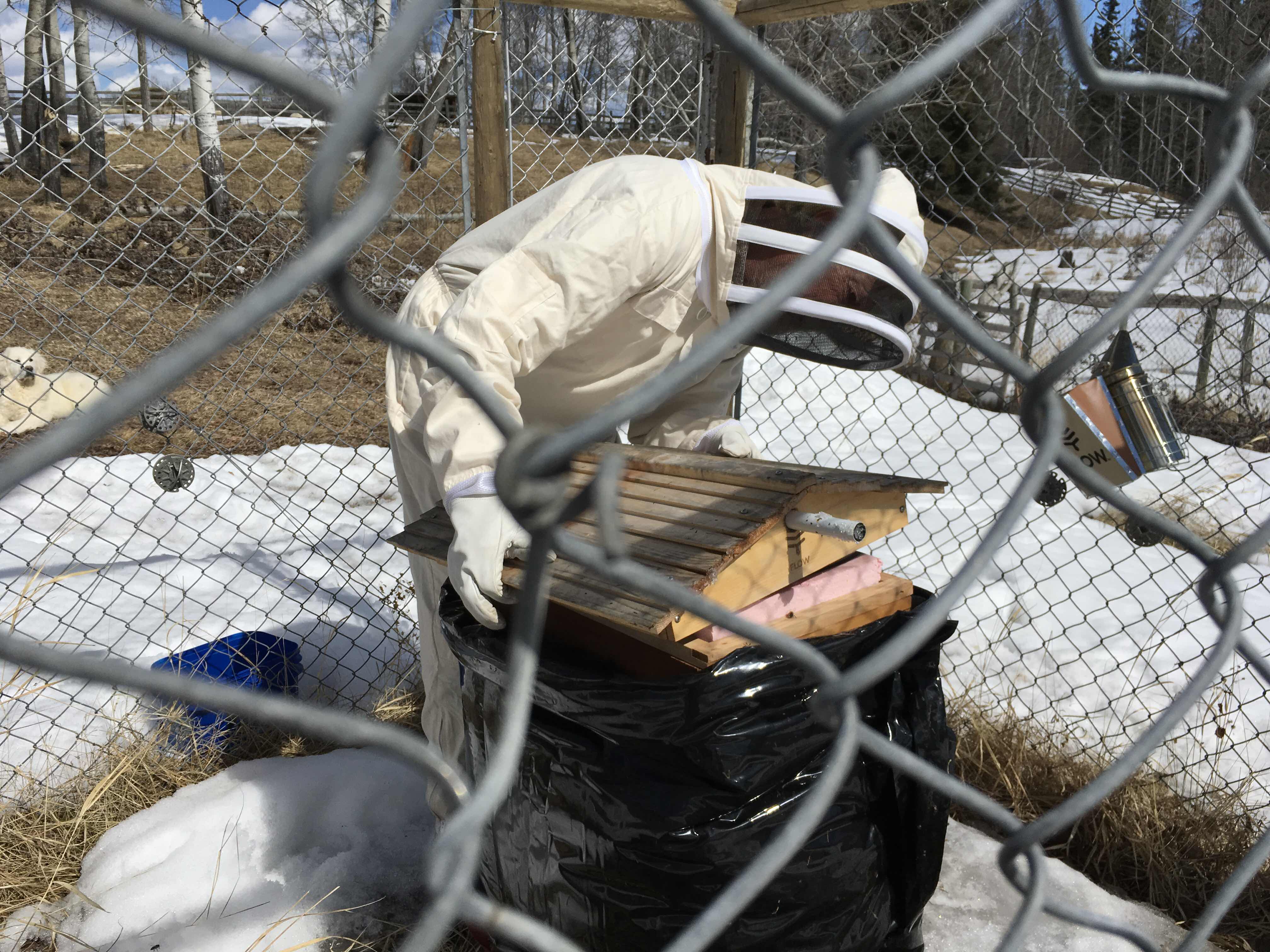
Adding a pollen cake and sugar water to help the bees get through early spring, which is still snowy. So far so good. They made it through! Many, many, many still alive. Now we wait for the pussy willows to bloom, their first source of pollen.


Shearing's Done!

It really went well, very professional shearing gal from Manitoba. We used to sell our lambs to her Dad years ago when they lived in Alberta. Sometimes it's difficult to get a shearer in for a small flock so we were really happy she was in the neighbourhood (High Prairie).

First we separated the lambs from the ewes.


Ewes in waiting.


Excellent!


Gone is that heavy winter coat.


Ready for the bagger.


Beautiful and magnificent!